Managing the Holidays: A Guide for Protecting Your Peace
Dec 03, 2025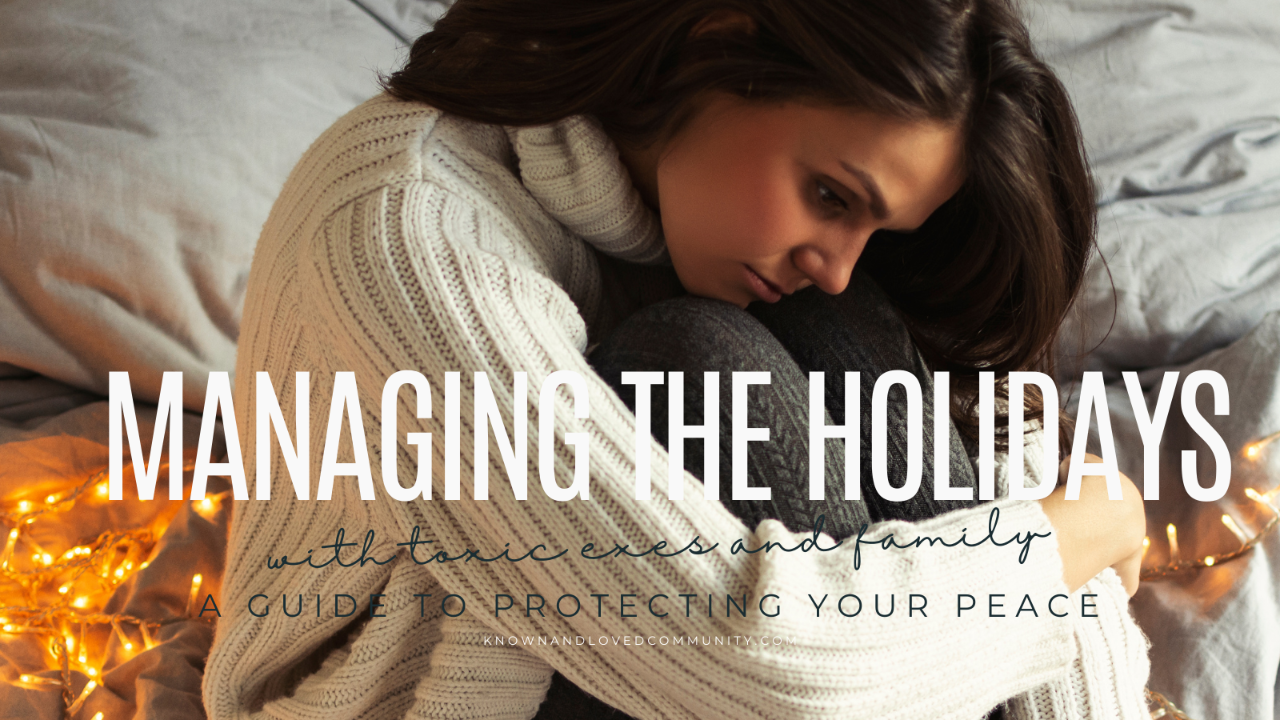
Managing the Holidays With Toxic Family or Exes: A Guide to Protecting Your Peace
The holiday season promises joy, connection, and celebration—but if you're navigating toxic family dynamics or a difficult ex, you know it also brings stress, emotional landmines, and complicated situations that test every boundary you've worked so hard to build. While the world around you glows with twinkle lights and cheerful commercials, the reality of facing unhealthy relationships during the holidays can feel heavy, draining, and overwhelming.
If this resonates with you, I want you to know: you're not alone. And more importantly—you're not powerless. You have more options than you think, and you deserve to experience peace during this season, even if it looks different than what everyone else expects.
Why the Holidays Feel So Hard
There's a reason the holidays amplify everything. Old family roles get reenacted like a script you never agreed to read from. Unresolved wounds resurface with shocking clarity. And the societal pressure to create "perfect memories" intensifies every interaction, every disappointment, every compromise you're expected to make. If you're co-parenting with a difficult ex, add in logistical stress, emotional triggers, custody battles, and boundary violations that threaten the fragile peace you've built the rest of the year.
This is why preparing yourself internally is just as important as planning your travel or menu. Maybe even more important. You can't protect your peace if you don't first acknowledge what you're actually walking into.
Start With Awareness
Getting clear on your emotional landscape is a powerful first step. Before you commit to any gathering, any schedule change, any compromise—pause and ask yourself: When I think about the upcoming holidays, what feelings show up first? Is it dread? Anxiety? Sadness? Obligation? Resentment? Name it. Don't judge it. Just notice it.
Then go deeper: Which past holiday experiences are influencing how I feel now? What parts of me feel most activated—my inner child who just wants to be seen and loved? My protector who's on high alert? My peacekeeper who wants to make everyone else comfortable? My fixer who thinks if I just try harder, it will finally be different this year?
Awareness gives you choice. You can't set boundaries or make aligned decisions unless you understand what you're actually responding to. And often, we're not responding to this year's holiday—we're responding to every painful holiday that came before it.
Define What You Want This Year
It's so easy to fall into "shoulds." I should attend because it's family. I should keep the peace because it's the holidays. I should do it for the kids. I should show up because it's tradition. I should be grateful. I should forgive and forget. I should pretend everything is fine.
But here's a powerful question that might change everything: If guilt or fear weren't part of the equation, how would you actually want to spend the holidays?
Sit with that. Really sit with it. What comes up when you remove the "shoulds" and ask yourself what you genuinely want? Maybe it's a quiet day at home. Maybe it's celebrating with chosen family instead of biological family. Maybe it's creating entirely new traditions that don't carry the weight of past pain. Maybe it's saying no to gatherings that consistently leave you feeling small, dismissed, or re-traumatized.
Your desires matter. Your well-being matters. And here's the truth that might feel radical: traditions can evolve, and so can you. You're not obligated to keep showing up to situations that harm you just because "that's how we've always done it."
Create Boundaries That Support Your Peace
Boundaries aren't walls—they're clarity. They're you getting honest about what you can and cannot accept, what you will and will not tolerate, what serves your healing and what undermines it. Boundaries help you choose what you allow into your emotional, physical, and mental space. And during the holidays, when everyone seems to have an opinion about what you "should" do, boundaries become your lifeline.
Consider: What limits feel essential for me this year? Maybe your boundary is about time—I'll stay for two hours, not the whole day. Maybe it's about topics—I won't discuss my personal life, my dating situation, my weight, or my parenting choices. Maybe it's about physical space—I need my own car so I can leave when I need to. Maybe it's about emotional energy—I will not engage in arguments, defend myself repeatedly, or absorb someone else's anger as if it's mine to fix.
Then ask yourself: What's my plan if someone pushes or ignores my boundary? Because here's what you need to know: they will push. Toxic people always do. They'll guilt-trip you ("But it's Christmas! How can you leave already?"), gaslight you ("You're being too sensitive"), or play the victim ("I guess I'm just a terrible mother/father/sibling"). Expecting this doesn't mean you're pessimistic—it means you're prepared.
And here's the most important part: a boundary isn't a boundary unless you're willing to enforce it. Pre-planning your response—calm, assertive, and simple—can make all the difference. "I understand you're disappointed, but I need to go now." "I've already answered that question." "I'm not discussing this today." You don't owe anyone an explanation for protecting yourself.
Prepare for Emotional Regulation
Toxic dynamics can activate old wounds quickly. One comment, one look, one "I'm just joking" can send you right back to feeling like that powerless child or that desperate partner who could never do anything right. To stay grounded when your nervous system starts screaming danger, you need tools ready.
Start by identifying your early signs of overwhelm. Does your chest tighten? Does your throat close up? Do you start sweating, shaking, or feeling dizzy? Do you suddenly want to flee or fight or freeze? Know your body's signals so you can intervene before you're completely dysregulated.
Practice grounding tools now, before you need them. Deep breathing—four counts in, hold for four, four counts out. Stepping outside for fresh air and a moment alone. Texting a safe friend who knows what you're walking into and can remind you that you're not crazy. Repeating a mantra: "I'm safe. I'm an adult. I can leave whenever I need to." Having a glass of water, feeling your feet on the ground, naming five things you can see.
And please—create an exit strategy if things escalate. This isn't dramatic; this is wise. Have your own car so you're not dependent on someone else's timeline. Have a pre-planned reason to leave if you need one ("I have another commitment"). Tell a friend to call you at a specific time so you have a built-in reason to step away. You don't have to stay somewhere you feel unsafe, disrespected, or drained—even if it's family. Even if it's a holiday. Even if people are upset about it.
If You're Co-Parenting With a Toxic Ex
Holidays can become battlegrounds when your ex thrives on conflict, control, or chaos. They may suddenly want to change the custody schedule, use gift-giving to compete or manipulate, involve the kids in adult conflicts, or create drama that destabilizes everyone. And the hardest part? You're expected to "be nice" and "compromise" and "think of the children"—as if you're not already doing exactly that while they weaponize every interaction.
To maintain stability for yourself and your kids, stick closely to written custody agreements. If it's not in writing, it didn't happen—and you're not obligated to accommodate every last-minute demand. Communicate briefly, factually, and without emotion. This is where gray rock becomes your best friend: boring, brief responses that give them nothing to latch onto. "The schedule is in the custody agreement." "That doesn't work for me." "I'll follow what the court outlined."
Avoid reacting to bait or guilt-tripping. They know exactly which buttons to push to get you emotional, defensive, or apologetic. Don't give them that power. When they say "You're keeping the kids from me" or "You're ruining Christmas," remember: that's manipulation, not truth. You're following an agreement. You're protecting boundaries. You're not the villain in their narrative, no matter how convincing their performance is.
And most importantly: prioritize what's best for your child—not what appeases the other parent. Your ex's feelings, opinions, or anger about how you spend your custody time are not your responsibility. Your child's safety, stability, and emotional wellbeing are. Sometimes those things are in direct conflict, and you have to choose your child. Every time.
Protecting your peace is also protecting your child's environment. They need at least one home where things are calm, consistent, and safe. Let that be the gift you give them this season.
Give Yourself Permission to Care for You
You are allowed to choose peace over tradition. You are allowed to change plans, decline invitations, or leave early. You are allowed to protect your energy. You are allowed to create a holiday experience that supports your well-being instead of destroying it.
I need you to really hear that, because I know how much pressure you're under. I know the voices in your head saying you're selfish, difficult, not trying hard enough, ruining everything for everyone else. But those voices are wrong. Protecting yourself isn't selfish—it's necessary. And anyone who makes you feel guilty for having limits isn't someone who has your best interest at heart.
Ask yourself: What do I need before, during, and after any challenging interaction? Maybe before, you need to journal, pray, call a friend, or remind yourself of your worth. Maybe during, you need to take breaks, have a safe person to text, or give yourself permission to feel whatever comes up. Maybe after, you need time alone to decompress, a good cry, a walk, or someone to debrief with who won't minimize what you experienced.
What expectations can you release to reduce pressure? Maybe you can let go of the perfect meal, the perfectly wrapped gifts, the appearance that everything is fine. Maybe you can release the hope that this year they'll finally see you, validate you, apologize, or change. Maybe you can release the belief that you have to earn your place at the table or prove you're worthy of love.
And who can you lean on for support? Who are your safe people—the ones who believe you, who don't minimize your experience, who want you to be healthy even when it's inconvenient for others? Lean into them. Let them remind you of the truth when you start doubting yourself.
Sometimes the most radical act of self-love during the holidays is saying no. No, I won't attend. No, I won't engage. No, I won't sacrifice my peace to maintain the illusion of a happy family. That "no" might feel selfish in the moment, but it's actually the sanest, healthiest thing you can do.
Create a Plan—and a New Vision
Instead of bracing yourself for the worst and just trying to survive, what if you took time to imagine something different? What does a "successful" holiday look like to you? Maybe success isn't everyone getting along or finally being seen by your family. Maybe success is you holding your boundaries. You leaving when you need to. You not apologizing for protecting yourself. You creating one moment of genuine peace or joy, even if it's small.
What memories do you want to create—either alone, with friends, or with chosen family? Maybe this is the year you start new traditions that actually feel life-giving. Maybe you host Friendsgiving with people who celebrate you. Maybe you spend Christmas morning in your pajamas watching movies with your kids. Maybe you volunteer somewhere that reminds you why the season matters. Maybe you take yourself on a trip, light candles, cook a meal you love, or simply rest.
What is one thing you can do to make this season feel more aligned with your values? If peace is your value, what does that require? If authenticity is your value, what does that mean for how you show up (or don't)? If protecting your healing is your value, what boundaries need to be in place?
Your holidays don't have to revolve around chaos you didn't choose. You get to write a different script. You get to decide what this season means for you.
Final Thoughts: You Are Not Obligated to Suffer
The holidays can be beautiful, but they don't have to be painful. You don't owe anyone access to you if that access harms your peace. You don't owe anyone your presence if your presence requires you to betray yourself.
You are allowed to protect yourself. You are allowed to choose differently this year. You are allowed to disappoint people who would rather see you suffer than see you set boundaries. You are allowed to create new traditions that honor your growth and healing instead of perpetuating dynamics that hurt you.
And if you're reading this feeling guilty, let me say it clearly: choosing yourself is not selfish. It's survival. It's sanity. It's the gift you give to your future self, your children, and everyone who genuinely loves you.
You're going to make it through this season. However imperfectly, you're going to make it. And you're allowed to do it your way.
You're not alone. You're seen. And you're worth protecting. 💛
If you are ready to break free from shame and experience emotional freedom, the Hope & Healing Community is the place to begin. We believe God's truth is stronger than confusion, and that you were created to live in freedom and peace.
Join my list!
Join my mailing list to receive the resources and encouragement.
Don't worry, your information will not be shared.
We hate SPAM. We will never sell your information, for any reason.
